
Employees need more from health and safety programs.
Addressing one of the most commonly asked questions marketing manufacturers ask today.
I recently had a chance to join a Safex webinar through the Ohio Manufacturing Association on wellbeing as the next step for health and safety programs.
Erin Pavlic walked through a topic that's been creeping up on every manufacturer I talk to: people are physically safer than ever, but they're not necessarily doing well.
Here's what stood out, and why I think it matters for our manufacturing clients:
It's time to think beyond safety.
Traditional safety programs were built to prevent injuries, fatalities, and regulatory citations. That work saved lives and still matters. But Erin made a point I hadn't heard framed quite this cleanly: organizations aren't prepared to help mitigate the full spectrum of risks workers face today.
Stress, workload, mental health, blurred work-life boundaries, burnout. None of that shows up in a lagging indicator until someone quits, calls off...or doesn't show up.
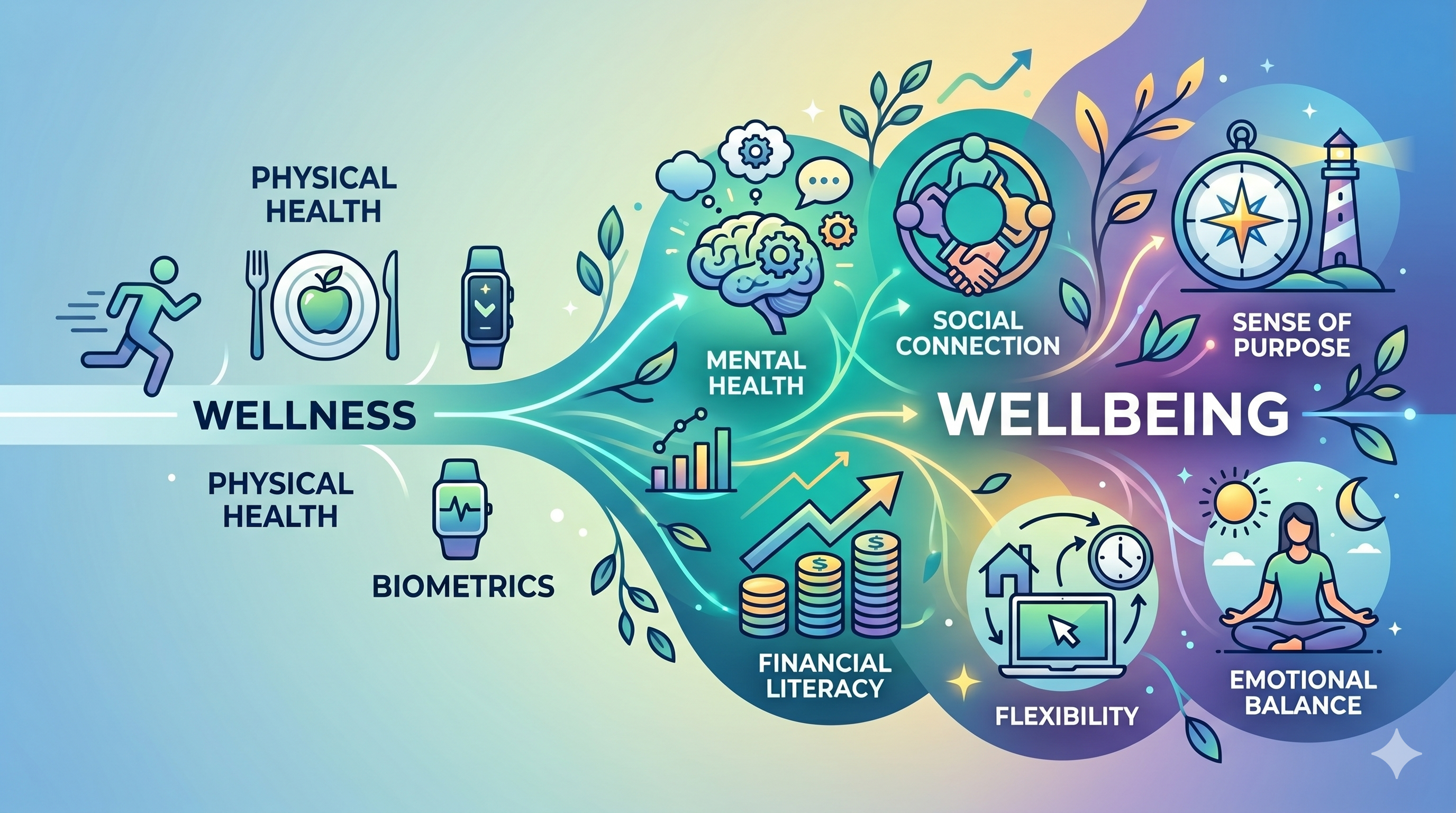
Wellbeing is the next layer. Safety prevents harm. Wellbeing promotes health. Leadership drives both.
Wellbeing goes beyond a step counter.
The webinar laid out six dimensions:
- Physical
- Emotional and financial
- Occupational
- Social and environmental
- Intellectual
- Spiritual
NIOSH's Total Worker Health framework adds workplace policies, culture, the physical environment, and what's happening at home and in the community.
Translation for a plant floor: wellbeing covers the obvious stuff (ergonomics, breakroom quality, benefits) and the less obvious stuff (training a supervisor to have a hard conversation, understanding how mandatory overtime is impacing someone's family, does the schedule respect sleep or create sleep depravation).
The hierarchy of controls still applies.
The slide that landed hardest for me was the hierarchy of controls reframed for wellbeing. It's the same logic safety leaders already use but applied to a broader set of risks:
- Eliminate the conditions that hurt people (unrealistic deadlines, mandatory overtime, redundant tasks)
- Substitute with healthier policies and practices
- Redesign the work environment for comfort, focus, and recovery
- Educate through training and EAP awareness
- Encourage personal change with tools like mindfulness apps or counseling access
How to actually get started.
The implementation path Erin walked through was straightforward:
- Assess readiness. Do you have leadership support and a culture that won't roll its eyes at this? Ex.: The ASSP Total Worker Health Readiness Checklist is a free place to start.
- Pick objectives that match your reality. Don't try to solve burnout, mental health access, and physical fitness at once. Pick what your data and your people are telling you matters most.
- Do a gap assessment. Most manufacturers already have wellbeing elements in place. They just haven't labeled them or connected them. The Mercer HERO Scorecard, NIOSH WellBQ, and the CDC Worksite Health Scorecard each answer a different question.
- Assemble a team. Leadership sponsor, program lead, HR, communications, EHS, facilities, IT, and actual employees. Not a committee of executives guessing what the floor needs.
- Set goals with leading and lagging indicators. Awareness, participation, manager confidence, EAP utilization. You'll see leading indicators move long before turnover or claims data does.
- Pilot first. Small population, single aspect, gather feedback, revise. The biggest wellbeing failures I've seen happen when companies skip the pilot and roll out a corporate-wide program nobody asked for.
The part most companies underestimate: Communication.
Communication shows up in several key ways: consistent messaging, benefit-focused language, leaders visibly talking about it, and stories of real impact.
So I’d add one more layer to what Erin was talking about: start with a communications audit to ensure all the hard work you’re about to put in will hit right, stick and be heard in a way that helps build wellbeing. Not just checks the wellness/wellbeing box.
If you want a partner on the communication side of your wellbeing program, such as internal rollouts, manager talking points and employee stories that get told (and people want to hear), we can help. We’re here to listen…and turn your goals into action.
Let's talk more. Check the form below or email me!
Written By Ben Brugler CEO, President
Explore These Topics