
Trade Shows: Are they worth it?
Upon further review...they are!
Editor's note: This is an updated version of a previously published blog to now reflect new trade show data.
Trade shows are dead.
Yep. And AI is just a fad.
The trade show industry is thriving. It is a $15B industry, projected to grow to $17B by 2028.
Sure, sure…but do they work?
Well, with all the talk about human connection and needing to break free of everything sounding like AI…the short answer is: yes.
The longer answer? See for yourself:
- Tradeshows account for 33% of a company’s new business.
- 46% of attendees are in the final stages of their buying decision.
- Attendees are more 74% more likely to buy because they met someone in person.
- 32% of a company’s marketing spend goes to tradeshows.
So, what did we just learn?
- Tradeshows still matter.
- People like buying from people.
- Half of those people are ready to buy.
And a third of your marketing budget goes to this so…it better be good.
But what does good look like? Whether you’re a tradeshow vet or someone who was handed the job because you’re in marketing, we’ve laid out some steps that help you capitalize on the investment and create an impact felt across the manufacturing organization.
Start with objectives you can explain (and defend)
Before you book anything or buy anything, answer this question: What does success look like for this show?
Don't skip this step. It's the foundation for every other decision you'll make, and it's what you'll use when your CEO asks "So, was it worth it?"
Here's a framework. Start by setting key objectives, such as:
Lead Generation
"Get leads" isn't an objective. Remember, nearly half of the people coming into your booth are ready to buy. So this is about finding qualified leads. "Generate 25 qualified conversations with companies in the automotive sector" or "Schedule 10 follow-up meetings with decision-makers before leaving the show” is where you want to focus.
Relationship Building
Trade shows are often the one time a year you can get face time with existing customers and target accounts. Objectives here might be: "Meet in person with our top 10 accounts" or "Have dinner conversations with five prospects we've been trying to reach all year."
Market Intelligence
Trade shows let you see what competitors are doing and hear directly from the market. Objectives might include: "Gather competitive information on three specific competitors' new offerings" or "Understand what challenges customers are talking about in our target segment."
Visibility
Sometimes the goal is being seen. This is harder to measure but still valid: "Position our company as a leader in this space" or "Launch our new capability to the industry." When you consider that 52% of exhibitors attend “because our customers do”, the bar to stand out and raise your profile is low.
The Preparation That Actually Matters
(This assumes your marketing and communications strategy is set. If not, well, that’s another blog…or a conversation with us.)
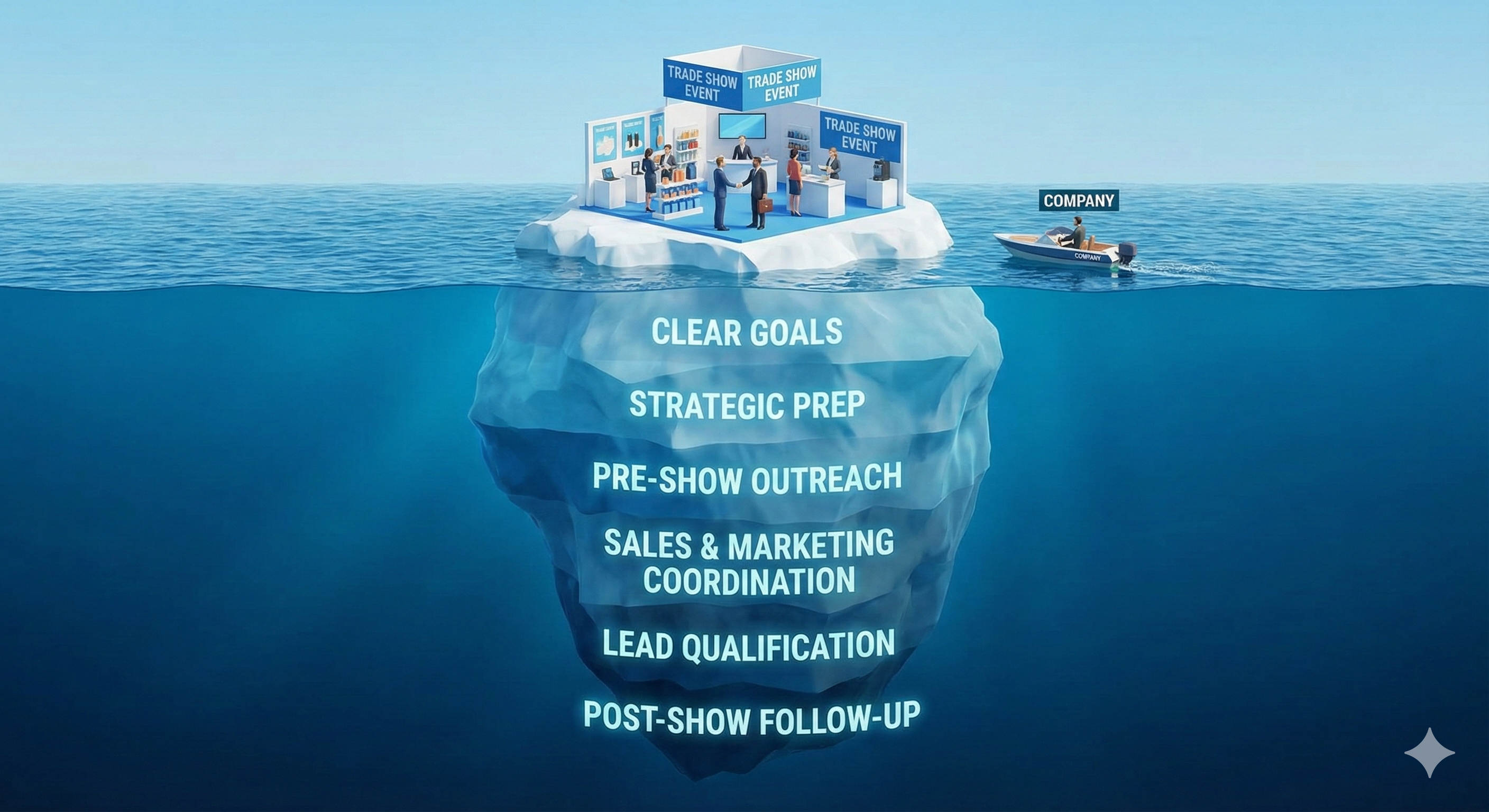
Here's something most people don't realize: the real competition doesn't happen on the show floor. It happens in the weeks before (when you should be scheduling meetings) and after (when your competitors are failing to follow up). This is where you win.
30-60 Days Before: Strategic Work
- Create your "A-list." Identify the 15-20 prospects and customers you most want to connect with at this show.
- Coordinate with your sales team. If you have salespeople, they need to know about this list and help reach out. Trade shows work best when sales and marketing coordinate.
- Confirm who's working the booth and what they'll do. Not everyone should do the same job. Some people are great at starting conversations. Others are better at technical deep-dives. Others at closing. Assign roles based on strengths.
- Book your off-floor time. Start making restaurant reservations and scheduling meetings outside the booth. There’s no such thing as ‘too early’ for this step.
About 30 Days Before: Tactical Execution
- Check all your physical materials. Signage, demos, brochures, giveaways—make sure everything exists, works, and looks professional. Nothing undermines credibility like a demo that doesn't work or a banner with last year's messaging.
- Brief your booth staff. What are the key messages? What product or capability are you emphasizing? What questions should they ask to qualify visitors? Consider creating a simple "booth script" so everyone's on the same page.
- Set up lead capture. Did you know that 94% of marketers believe their company fails to convert show leads? Don’t be a statistic. And don’t leave lead conversion to chance. Be ready to answer questions like: How will you record information about the people you talk to? Have you tested all of the equipment? Do you have a shared document set-up to track (HubSpot anyone?) and coordinate with sales? How will you score and follow-up with leads?
7-10 Days Before: Final Details
- Confirm all scheduled meetings
- Do a final walkthrough with staff on qualification criteria and follow-up responsibilities
- Set up a shared document or chat thread for real-time notes during the show
- Designate someone to capture photos and content for social media or internal updates
- Triple-check administrative details: hotel, flights, car rentals, restaurant reservations
At the Show: What Matters Most
When the show starts, most of your decisions are already made. Now it's about execution.
The Qualification Question
Train your booth staff to qualify before presenting. A simple opening question like "What brought you to our booth today?" tells you immediately whether you're talking to a potential customer, a competitor, or someone who just wanted the free pen. This saves time and ensures your best conversations happen with the right people.
Competitive Intelligence and Industry Trends
Do you have a team ready to walk the floor to gather competitive intel? Updates from the industry? Insights from suppliers? Consider bringing in your agency or consultants to do this without the burden of a nametag that has your company’s name printed on it.
Team Discipline
This sounds basic, but it matters: no phones in the booth, no sitting, no eating during show hours. These things signal that you're not serious about being there. Rotate breaks so the booth always has energy. And do a short team debrief at the end of each day to share what you're learning and adjust if needed.
After the Show: Where Most Companies Drop the Ball
This is the moment of truth. Most trade show investments fail not because of what happened at the show, but because of what didn't happen after.
Within 48 Hours
Did I mention 94% of marketers feel the show leads aren’t followed up on?
Assign follow-up ownership: every lead should have one person responsible for it. Then send personalized follow-up to all qualified leads. "Personalized" isn’t a nice to have. Make sure the person owning it understands this. It means the difference between "It was great meeting you at the show" (bad) and "I enjoyed discussing your challenges with aluminum welding in high-humidity environments" (good).
2-4 Weeks Post-Show
This is when the real work begins. Complete every promised follow-up. Move qualified opportunities into your sales process. Share the intelligence you gathered with relevant teams. For example, product development might want to know what customers need or what pain points they’re experiencing; sales might benefit from competitive insights.
Finally, hold a team postmortem. What worked? What didn't? What would you do differently? Document this so you're not starting from scratch next time.
The Bottom Line
Trade show success isn't about having the biggest booth or the flashiest materials. It's about preparation, focus, and follow-through. Set clear objectives that align with your business goals. Do the strategic work early. Execute with discipline at the show. And treat it like the investment it is. (A third of your marketing budget!!)
The framework above is a starting point to help turn your trade show from a question mark into a measurable investment. The form below is to contact us so we can help. (Or you can just email me.)
Sources: Cvent; Statista
Written By Ben Brugler CEO, President
Explore These Topics